Ernest Cole
Vintage Photographic Print from HOUSE OF BONDAGE
16.2 x 24.2cm (6.4 x 9.5 inches)
Signed
1965
Dimensions: 16.2 x 24.2cm ( 6.4 x 9.5 inches )
Silver Gelatin Print.
Signed by E. L. Cole
Condition: Very good, slight signs of wear to the edges.
Verso: Stamps of the ABC Press, Amsterdam and Magnum Photos, N.Y.C. and signature
Ernest Cole’s House of Bondage (1967, 2022) was banned in South Africa under apartheid. It is considered one of the most important photobooks in South African photographic history. As Martin Parr and Gerry Badger state in The Photobook: A History, ‘the comprehensiveness and humanity of its [House of Bondage’s] view is the reason for both its banning in South Africa and the plaudits it garnered elsewhere.’
Throughout the book, Cole masterfully documented apartheid’s methods of bureaucratic control. He exposed the dramatic, brutal, and tragic intersection of what Michel Foucault referred to as ‘sovereign power’ and the scientific method of ‘disciplinary control.’
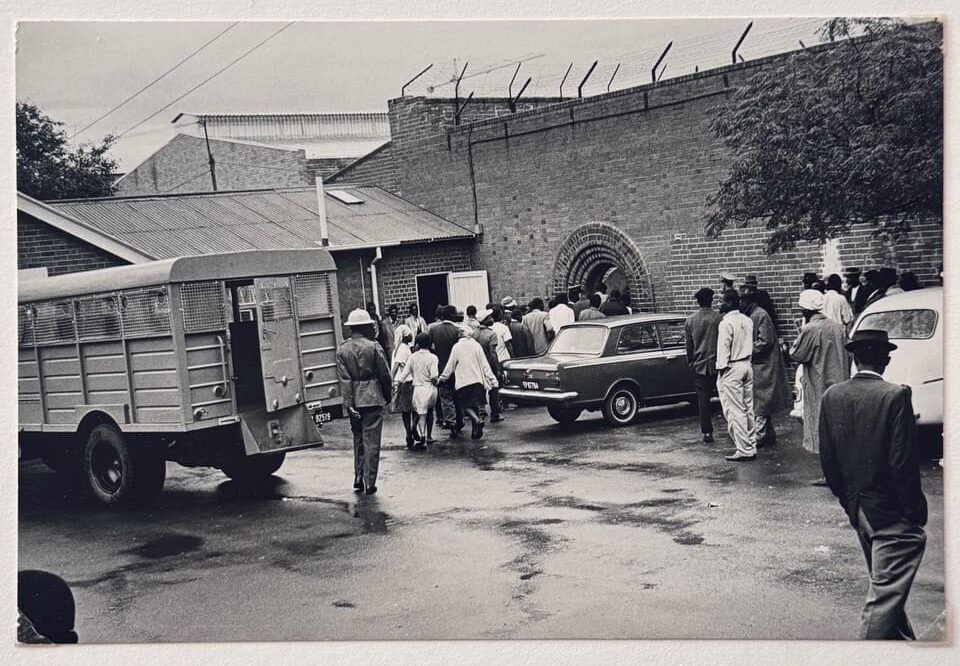
The image in question is a photograph of prisoners lining up at the entrance to the Bantu Commissioner’s Court in Johannesburg. Hundreds of thousands of Black South Africans were processed through this steel door for failing to produce their passbook (dompas). Sentences ranged from fines, to floggings, to being forcibly removed from urban areas and ‘sent back’ to a ‘homeland’ or ‘native reserve’ associated with a language group or tribe.
In Cole’s image, the building’s façade suggests little of what lies behind it. The Black policeman, or askari, stands neatly dressed in a colonial-era pith helmet. As Achille Mbembe suggests when discussing Cole’s photography, ‘life under apartheid was lived in-between and behind the lines.’ The two figures that most symbolised this ‘betweenness’ were the nanny and the policeman. The interpellation enacted by the presence of the Black policeman in Cole’s image draws the viewer into the complexity of apartheid, breaking the illusion of a complete segregation.
As Hlonipha Mokoena has suggested, in her recent work on the colonial Black policeman on the mines, Black policemen used these roles to carve out distinct economic and social opportunities in restrictive apartheid settings.
The Black sentinel’s gaze, as well as those of other bystanders in the foreground and background, suggests an interested detachment toward the fate of the prisoners. The prisoners’ ordinariness and innocence are revealed subtly through the simple familial affection displayed by the two women who hold the hands of a shoeless child.
The police truck, with its door recently opened, plays a distinct role in the image’s narrative. These police vehicles had by then become synonymous with apartheid oppression of the 1960s and with the Treason and Rivonia Trials. In this case, they are transporting not ‘terrorists’ or ‘enemies of the state’ but simple people caught up in a system of racist bureaucratic control.
The image is a wonderful example from House of Bondage, revealing the quotidian ordinariness of apartheid. It is typical of Cole’s point-of-view, medium-angle photographs, using a geometric framing that draws the eye toward the subject — in this case, the ordinary people walking through the arched doorway. It is an angle repeated throughout the book. Its method of storytelling draws the eye across a human tableau, building the narrative of apartheid’s control and its methods.